Project Description
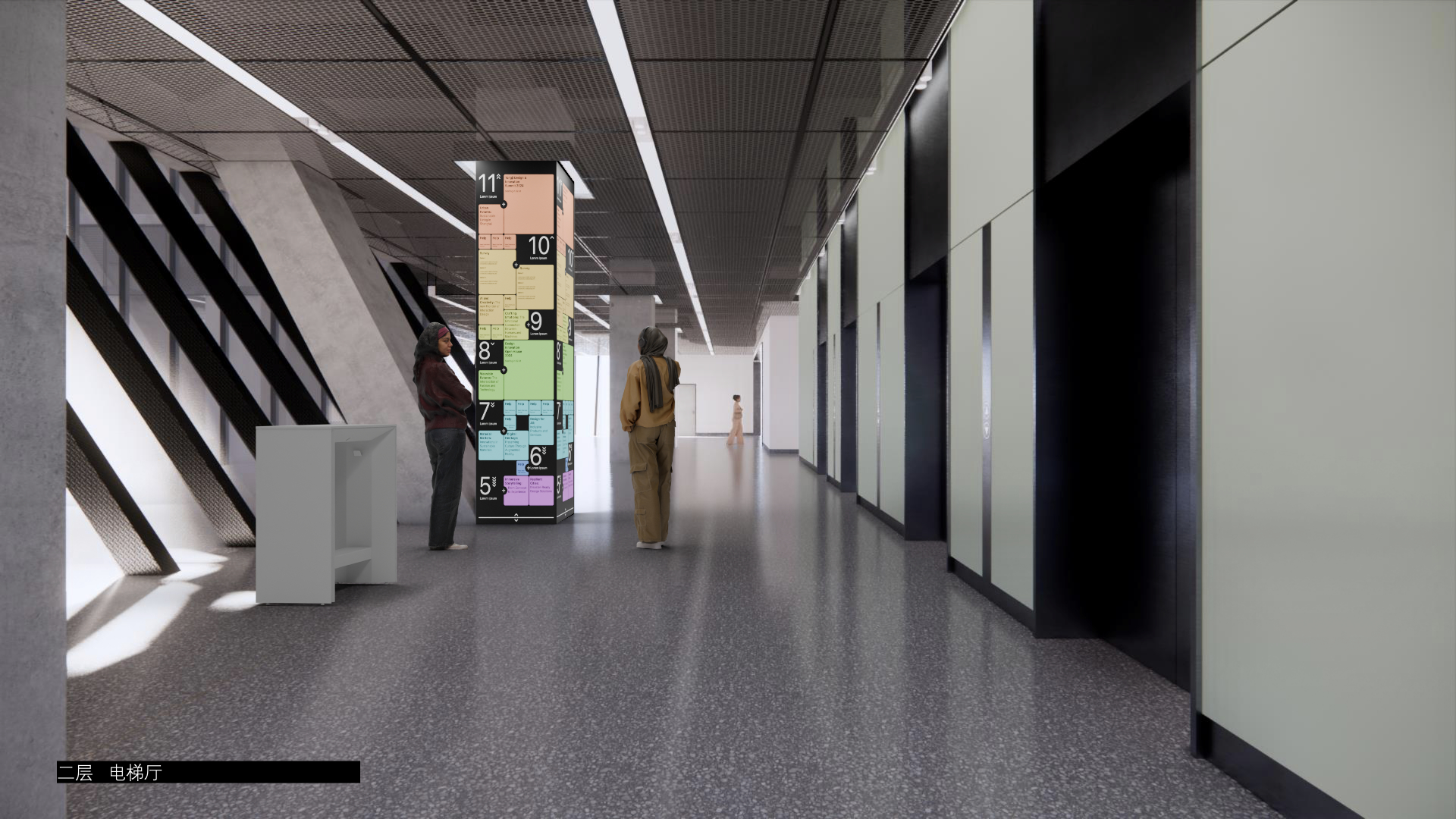
Initiated at the Tongji University College of Design and Innovation (D&I), this project addresses the challenge of social fragmentation caused by the transition to a new, vertically oriented building. While the old campus fostered spontaneous encounters through horizontal flow, the vertical layout threatened to isolate floors. CollabColumn is a phygital interface system consisting of interactive digital columns located at elevator hubs and a WeChat mini-program. It acts as a digital anchor that restores transparency by visualizing ongoing activities and events across all floors. By allowing users to create and interact with digital "pins" in physical space, CollabColumn promotes cross-floor exchange and preserves the community's dynamic identity.
Role & Scope:
This project was a solo effort over five weeks. I was responsible for the entire design process, including problem framing, research, concept development, interaction design, prototyping, and system logic. The project was initiated and developed within the academic context of the Tongji University College of Design and Innovation.
Research / Methods
The project began with an on-site analysis of the new D&I building during and shortly after its construction phase, focusing on how the architectural shift from a horizontally organized space to a vertically structured environment affected everyday interaction within the D&I community. This initial analysis highlighted a fundamental change in movement patterns, visibility, and informal meeting points. Building on this the project was driven by a deep reflection on the D&I community's social dynamics including a critical analysis of the "spontaneous encounter" culture in the old D&I building and how it was lost in the new vertical structure. To understand how spatial identity shifts from horizontal to vertical architecture, I developed an experimental research approach called the “verticalizer” prototype. By restricting my horizontal field of vision, I experienced the old D&I building from a predominantly vertical perspective, mirroring the spatial logic of the new building. This embodied exploration helped uncover which social cues and interaction moments were lost, transformed, or amplified in a vertical environment.